
CAF’s Disgrace: How Biased Officiating Blighted the AFCON Final
By Farid Abdulhamid
The chaotic scenes that engulfed the AFCON 2025 final were not an accident, nor were they the result of poor sportsmanship by Senegal. They were the inevitable outcome of years of biased officiating by the Confederation of African Football (CAF), finally collapsing under the weight of its own contradictions on the biggest stage of African football.
Throughout the tournament, there was a growing perception that CAF was determined to see Morocco crowned champions, driven less by footballing merit and more by sponsorship deals, politics, and Morocco’s commercial importance to the Confederation including its 2030 World Cup hosting rights. That long-suspected plot unraveled spectacularly in the final, exposing the rot at the heart of CAF’s governance.
Tension was building up prior to the final with the Senegalese Football Federation (FSF) protesting against the mistreatment of its players. Rather than booking a flight from Tangier to Rabat, CAF forced the Senegalese players to endure a train journey exposing them to security risks that are harder to control than in tightly managed environments like chartered flights or secured buses. Furthermore, trains are public spaces with unpredictable crowds making it easier for hostile fans to accost players from an opposing camp in emotionally-charged matches like an AFCON final. The FSF criticized the lack of security arrangements for the team’s arrival in Rabat, problems with the accommodation, issues with training facilities and difficulties of getting a fair ticket allocation for its fans.
At the center of the controversy was disgraceful officiating intended to alter the outcome of the match in favor of Morocco. Senegal were denied a legitimate goal that should have secured them the title within 90 minutes after Ismaila Sarr’s goal was disallowed with Addoulaye Seck unfairly penalized for a slight push on Achraf Hakimi. Moments later, Morocco were awarded a soft, highly questionable penalty that instigated the ensuing chaos.
These decisions were not minor errors; they were match-defining calls that confirmed the worst fears of fans and players alike. When referees repeatedly make decisions that favor one team in crucial moments, especially in games involving Morocco, it ceases to be coincidence and becomes a pattern.
In a resultant fracas, Senegalese fans attempted to storm the pitch but were held back by lines of police cordon. Senegalese manager Pape Thiaw pulled his players off the field in protest leading to a 14 minutes suspension of the game. One of the sports’ greatest stars and Sportsmen, Sadio Mane, Africa’s foremost football ambassador, intervened, convincing his aggrieved teammates to return to the pitch. Real Madrid’s Brahim Diaz took the contested penalty but his attempted panenka shot was comfortably saved by Senegalese goalie, Edouard Mendy pushing the game into extra-time.
In the 4th minute of extra-time, Senegal’s Pape Gueye made a powerful run fending off Moroccan defenders before unleashing a laser of a shot that struck the underside before landing on the back of the net. The solitary goal ensured Senegal secured their second AFCON title after winning the 2022 edition three years ago. Senegal fully-deserved to lift the AFCON title being the overall best team throughout the tournament. Senegal have a World Cup date with Toronto as the Teranga Lions will take on the winner of FIFA Playoff 2 pathway featuring Bolivia/Suriname v Iraq at the BMO Stadium
CAF’s attempt to shift blame onto the Senegalese manager and players is both cynical and dishonest. The anger and reactions seen on the pitch and in the stands were not acts of indiscipline, but a form of resistance to an unjust system that had denied Senegal fair treatment. Expecting players to remain calm and silent after being robbed on the grandest stage of African football is not realism—it is hypocrisy. Passion, protest, and even confrontation are predictable responses when footballers feel cheated by those entrusted with protecting the integrity of the game.
Far from tarnishing the image of African football, Senegal’s reaction exposed the real disgrace: CAF’s persistent favoritism and failure to ensure credible, neutral officiating. If African football’s reputation suffered at the AFCON final, responsibility lies squarely with CAF, not with players who stood up against injustice. The confederation cannot continue to hide behind disciplinary rhetoric while ignoring the structural bias that fuels these explosions of anger. Until CAF confronts its own conduct and ends the culture of favoritism, chaos like this will not be the exception—it will be the rule.
CAF’s manipulation of the AFCON tournament did not begin in the final—it started much earlier, with dubious last-minute changes to match officials that conveniently favored Morocco’s path to the final. In a competition where transparency and neutrality are essential, CAF’s sudden reshuffling of referees before key knockout matches raised serious red flags. These changes were not properly explained, nor were they justified on technical or performance grounds, reinforcing the widespread belief that officiating assignments were being engineered to produce a preferred outcome rather than to uphold fair play.
In the final match, Senegal did not disgrace African football by reacting to injustice; CAF disgraced it by orchestrating a match where the outcome appeared predetermined.
Apart from overt biased officiating driven by commercial interests, CAF has failed to keep politics out of African football. A case in point was the abrupt pre-match replacement of Somali referee and Africa’s top match official, Omar Abdulkadir Artan who was slated to officiate the quarterfinal match between Nigeria and Algeria. Just weeks earlier, CAF named Artan as the African referee of the year 2025.
Artan was one of the outstanding tournament referees delivering consistent, confident and high-quality officiating on the pitch. CAF claimed Artan violated boot branding even though there are no clear rules regarding official branding. A match official should only be sanctioned on technicality not contractual grounds.
The replacement of Artan was intended to scuttle Algeria’s potential progress into the semi-finals, where they would have been paired against Morocco, a geopolitical arch-rival in the region. At the end of the match that ended in 2-0 victory for Nigeria, Algerian players reacted angrily confronting the match official for what they perceived were questionable calls including a penalty shout. Regardless, there is no taking anything away from Nigeria as they dominated the game with Algeria on the back foot for long spells of the match. However, it is worth noting that Algeria has long endured unfair treatment under CAF in previous AFCON games owing to Morocco’s growing influence over African football governance.
For many observers, this match illustrated a dangerous reality: CAF has allowed continental politics to contaminate the integrity of the game. For decades, Algeria has been locked into a regional conflict with Morocco over the status of Sahrawi Arab Republic (Western Sahara), which remains under Rabat occupation. Algeria backs the independence of the Sahrawi Republic and had long supported the Polisario Front, a Sahrawi National Liberation Movement seeking to end the Occupation of Western Sahara through armed resistance and diplomacy. The Toronto and Montreal based GRILA, a Pan-African organization, has long championed the struggle, independence and inalienable rights to self-determination by the Sahrawi people.
When refereeing appointments and on-field decisions begin to mirror geopolitical rivalries—particularly one as sensitive as the Sahrawi conflict—football becomes a proxy battlefield rather than a unifying force. The spillover of the Sahrawi dispute into African football not only undermines trust in CAF competitions but also threatens the credibility of the sport across the continent. Until CAF restores transparency, neutrality, and independence in officiating, African football will continue to pay the price for political conflicts it should never have been dragged into.
AFCON is heading to East Africa with the 2027 edition being co-hosted by Kenya, Uganda and Tanzania. Kenya’s 60,000 seater, the yet to be launched world-class Talanta Stadium will host the 2027 AFCON Final. In readiness for that showpiece, the first-ever AFCON to be hosted on East African soil, CAF needs to put its house in order to ensure a smooth, scandal-free tournament.
What is Driving the Gen Z Protests in Africa?
By Farid Abdulhamid
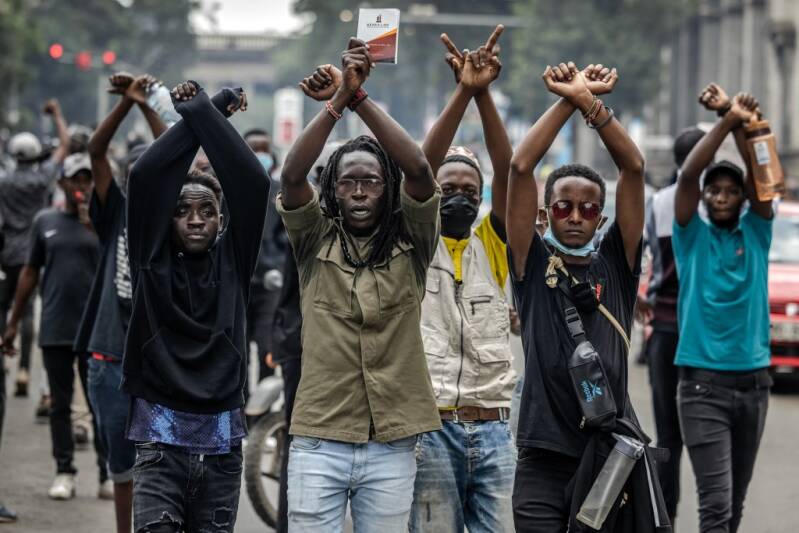
The wave of protests sweeping across Africa led by young people — commonly tagged as “Gen Z protests” reflects a shifting dynamic in social mobilization. Protests have erupted in Kenya, Tanzania, Morocco, Madagascar and Cameroon among other countries. Issues range from tax reforms, electoral politics, corruption, cost of living crisis as well as state patronage and bad governance blamed on the old-guard.
The most common cause fueling Gen Z-led unrest is high youth unemployment & economic insecurity:
Many African countries have very large youth cohorts entering the labour market, yet job creation is not keeping up. According to one report: “working-age population will expand by more than 600 million over the next 25 years” in sub-Saharan Africa.
Another key factor driving the protests is the rising cost of living & inflation. The pandemic, supply-chain shocks and global crises (e.g., Ukraine war) have pushed up food and fuel prices, squeezing young people who often already had precarious livelihoods.
Analysts also point to the poor quality or under-investment in public services. Many protests centre around basic public services—healthcare, education, infrastructure. For example in Morocco, youth under the banner “Gen Z 212” demanded “better health and education” and lambasted big spending on sports infrastructure while hospitals and schools remain neglected.
Likewise, unresponsive governments, and endemic state corruption have sparked protests in a number of restive countries. Young people often feel excluded from decision-making, and frustrated by governments that appear unresponsive or mired in patronage.
Mismatch between visible state spending and everyday reality is a recurring trigger of protests. Governments investing visibly in mega projects (state of the art stadiums etc) while everyday services lag has antagonized protesters. In Morocco the dominant slogan among protesters was “We want hospitals, not stadiums.”
Digital connectivity + global awareness has empowered Africa’s Gen Z’s to take to the streets and make demands. This generation is highly networked and able to compare their situation with peers around the world. They are less willing to accept status-quo.
Equipped with smartphones, and social media, they are disrupting the established order and shaking the status quo.
In most cases, particularly during the Kenyan anti-tax revolt, Gen Z’s mode of mobilization was rooted in a leaderless / decentralized/non-tribal movement. Unlike traditional protests which often had prominent leadership or party backing, many Gen Z protests are spontaneous, networked, and without central figures.
Such leaderless movements are difficult for authorities to track, demobilize, negotiate with, or co-opt.
Perhaps the biggest weapon in the hands of the Gen Z’s is the extensive use of social media & digital tools. Platforms like TikTok, Facebook, Discord, WhatsApp, Instagram are used to organise, spread awareness and mobilise quickly.
In Kenya, for instance, hashtags such as #RejectFinanceBill2024 trended and videos on popular platforms translated the detrimental effects of the bill in local dialects.
Often times, the result is a rapid spill-over from online forums into the streets. A local grievance (e.g., a policy change, death in a police custody, tax hike) can become a national movement within days through digital amplification where tools designed for entertainment are turned into instruments of revolution.
By far, the Gen Z protests in the continent are not ideologically-driven. Rather than being dogmatic, the essence of the demos appear pragmatic, with a focus on everyday rights & services rather than ideological agendas. Hence many of the demands are concrete: jobs, better schools, reliable healthcare, less corruption.
Consequently, the protests are described as “apolitical … focusing on tangible service delivery rather than ideological positions." Generally, the youth utilize digital activism, art (murals, music) and street demonstrations.
While largely peaceful, the Kenyan protests against Finance Bill 2024 took a violent turn when goons descended on the streets looting and causing wanton destruction in Nairobi’s central business district while a group of protesters breached the Kenya Parliament precincts setting on fire a section of the building. The Kenyan government claimed the protests were infiltrated and hijacked by a group of organized criminals bent on causing mayhem on the streets.
Yielding to the protesters, the Kenyan government rescinded the Finance Bill tabling a watered-down version.
What are the potential implications for the protests?
Governments may increasingly feel pressure from younger voters — With youth making up large portions of the population in many African countries, their voices matter not just culturally but politically.
The protests may force policy shift toward social services. The emphasis on “jobs, health, education” may push priorities away from large infrastructure projects toward social-service delivery mechanisms.
The risk of repression & instability remains particularly high. Many of these protests have been met with heavy-handed responses (arrests, abductions, extra-judicial killings, force) and if young people feel unheard, it could lead to further escalation.
The street demos may spark new forms of civic participation given that this generation might be less inclined to traditional party politics and more in tune with digital activism, street action, issue-based organizing.
Gen Z mobilization also faces the challenge of sustainability. Some analysts point out the leaderless structure makes long-term strategy and negotiation harder. At the same time, it makes the consolidation of the movement difficult.
Given the spontaneous nature of the protests, the movement may lose steam. It remains to be seen whether the street mobilizations may adopt a leadership structure coupled with ideological paradigms that can sustain a long-term vision and a well-defined political roadmap critical in sustaining the longevity of the movement.

A former Research Fellow at the Centre for International and Security Studies, Farid Abdulhamid is a Political Analyst and a Geopolitical Commentator based in Toronto.
farid@focusconsult.org
Our history
From modest beginnings, we've grown through unwavering dedication and a commitment to continuous improvement. Each step has reinforced our core belief in the power of collaboration and the importance of integrity. We're passionate about what we do, and we're excited to share our story with you.
Create Your Own Website With Webador